Red Light Therapy Product Manufacturers
Official Site Only: ideatherapy.com | Beware of Counterfeits















Red Light Mats vs Panels for Wellness Businesses
Choose red light mats for a planned lying-down service when the support surface, cleaning process and storage method fit your operation. Consider panels when an approved mounting system better supports your intended client position. Neither format is the universal winner for a wellness business.
Comparing red light mats vs panels means testing room use, staff workload and the complete booking cycle. LED counts and headline power ratings cannot settle those operational questions. A documented sample trial provides a stronger basis for purchasing.

Compare the TLB1800 mat and RLUltra1000 panel against your service format and room requirements.
When Red Light Mats Fit Your Service
A mat supports a lying-down format, while a panel can accommodate different positions through its approved mounting arrangement. Decide whether clients will use a dedicated room or a space that also hosts other activities. Record who prepares the equipment, explains the controls and resets the room afterward.
For businesses developing a service around existing classes, IDEATHERAPY’s yoga and Pilates studio solutions offer a starting point for discussing formats. The next step is a floor plan and a supervised sample trial using the intended furniture, power location and staff procedure.
Red Light Mats vs Panels: Two Product Examples
The TLB1800 full-body red light mat and RLUltra1000 full-body panel illustrate the practical differences. The specifications below are published product details; operating arrangements still need to be agreed for the supplied configuration.
| Purchasing question | TLB1800 mat | RLUltra1000 panel |
|---|---|---|
| Physical format | Flexible full-body mat | Rigid full-body panel |
| Published dimensions | 1800 × 800 × 15 mm (about 70.9 × 31.5 × 0.6 in) | 65.12 × 16.54 × 2.56 in (about 1654 × 420 × 65 mm) |
| Listed net weight | 4.2 kg ±5% | 31 kg ±0.5 kg |
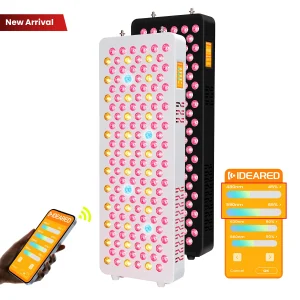
| Published controls | Touch controller; timing, brightness and memory | Touchscreen, app and voice control |
| Room planning priority | Supporting surface, client access and storage | Mounting system, user position and access space |
| Key purchase clarification | Approved support, cleaning and storage method | Installation accessories are sold separately |
These examples compare equipment formats, not treatment outcomes. The number of LEDs or available settings does not establish that either device is preferable for a particular client.
Calculate the Working Footprint
Product dimensions describe the equipment, not the room it needs. A mat layout must include space for clients to lie down and get up, staff access, the controller and cable routing. If using a raised surface, confirm compatibility, support dimensions and permitted setup with the supplier. Consider client mobility and comfort when choosing floor-level or raised positioning.
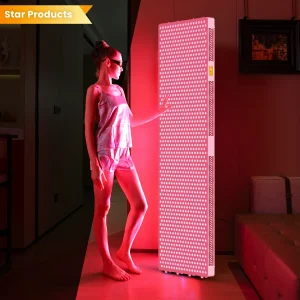
For a panel, include the base or wall mounting arrangement, the operating distance specified in its instructions and clear circulation space. The RLUltra1000 page lists roller-base, horizontal and wall-mount options. Obtain the complete installation drawing before ordering furniture or fixing wall positions.
Test the proposed layout with doors open and equipment in use. Check access to controls and the power connection without moving furniture or stepping across cables.

Allow space for the RLUltra1000 mounting system, staff access and the intended client position.
Cleaning Red Light Mats and Panel Setups
A shared mat puts its usable surface at the center of the cleaning procedure. Request written instructions covering compatible cleaning products, application method, drying and inspection. Check seams, cable connections and the controller during the trial. Add covers or linens only if the manufacturer confirms their compatibility with operation and cleaning.
A panel setup may avoid body contact with the light-emitting surface, but shared controls, handles and furniture still require attention. Specify the cleaning procedure for the complete room rather than treating a non-contact format as maintenance-free.
Measure the time needed for preparation, positioning, the instructed operating period, cleaning, drying and inspection. Use that complete cycle for booking capacity. A timer setting alone does not represent room availability, and cleaning time should not be compressed to meet an optimistic schedule.

Include the mat surface, edge, cable and controller in the equipment inspection procedure.
Evaluate Comfort and Control During a Trial
Comfort depends on the whole setup: support surface, posture, access, room temperature and the ability to reach assistance. Ask staff to demonstrate entry, positioning and exit with the proposed arrangement. Observe equipment noise and warmth under the intended operating conditions.
On the TLB1800, check how timing, brightness and memory behave when the next session begins. On the RLUltra1000, assess touchscreen access and app or voice operation in the actual room. With multiple devices, verify how staff identify and control the intended unit.
Document the startup, stop and reset procedure. Confirm available control restrictions rather than assuming a commercial interface prevents unintended changes.

Confirm controller operation and staff training requirements on the approved product sample.
Turn the Comparison into a Purchase Specification
Use the custom panel buyer requirements guide to document room conditions, controls, installation and sample acceptance. For either format, obtain the exact model, electrical rating, destination-market plug, manual, accessory list and applicable documentation.
Record the agreed cleaning method, operating limits, inspection points and staff instructions. Include replacement-controller availability, service responsibilities and warranty terms for the intended business use. The manufacturer selection guide explains how approved specifications, traceability and change control support repeat orders.
Compare total deployment cost: equipment, installation, furniture, freight, import charges, staff preparation, cleaning materials, maintenance and spare parts. Separate confirmed quotations from assumptions. A useful red light mats vs panels decision records both the chosen configuration and the operational conditions behind it.
FAQ
Which format suits a multipurpose wellness room?
Compare the complete changeover process. A flexible mat may suit a room that changes activities, provided its approved storage method and setup procedure work for staff. A panel requires a suitable mounting and parking arrangement. Trial both against the room’s schedule.
Are panels easier to clean than mats?
There is no universal answer. Surface materials, approved cleaning methods, contact points and furniture all affect the task. Compare the complete cleaning and drying procedure on the actual samples, including controls and accessories.
Should a business buy both formats immediately?
Start with the service requirement. Two formats make sense when they serve distinct positioning or workflow needs and the room can accommodate them. Confirm those differences through a trial before expanding the equipment list.
Request a Configuration for Your Facility
Share your room dimensions, intended client position, service workflow, destination country and quantity with IDEATHERAPY. Include any cleaning or installation constraints so the quotation addresses the complete setup.
For branded equipment, review the available product customization services and define the required changes. Then request a product and configuration review, including current specifications, installation options, sample pricing and the documentation needed for your project.






 简体中文
 Deutsch
 Français
 Português
 Italiano
 Русский
 한국어
 العربية
 日本語
 Svenska
 Polski
 Magyar
 Čeština
 Dansk
 繁體中文
 Nederlands
 Suomi
 Irish