Red Light Therapy Product Manufacturers
Official Site Only: ideatherapy.com | Beware of Counterfeits















Characteristics of High-Quality Red Light Therapy Devices
A quality device is not defined by the largest wattage number on a product page. High-quality red light therapy devices make their performance measurable: they disclose wavelengths, irradiance at stated distances, treatment area, controls, safety protections and the test conditions behind each specification.
Quick answer: buyers should look for transparent optical data, even coverage, stable thermal design, practical controls, traceable safety documentation and claims that match the device’s intended use. A polished housing can be useful, but it cannot compensate for incomplete measurements or unclear compliance information.
What Defines High-Quality Red Light Therapy Devices?
The best way to evaluate a panel is to treat it as a complete light-delivery system rather than a collection of LEDs. Wavelength, irradiance, dose, distance, coverage, beam angle, operating mode and session time interact with one another. An NIH-hosted review of photobiomodulation parameters explains why reporting only total wattage is not enough to predict the light delivered over a treatment area.
1. Clearly Disclosed Wavelengths
A credible specification should list exact wavelengths in nanometers, not simply say “red and infrared.” Common panel configurations may combine visible red wavelengths such as 630nm, 650nm, 660nm or 670nm with near-infrared wavelengths such as 810nm, 830nm, 850nm or 1060nm.
More wavelengths do not automatically mean a better device. Buyers should ask how the LEDs are distributed, whether wavelength groups can be controlled independently and whether the selected spectrum matches the intended application. The 660nm vs 850nm wavelength comparison provides a useful starting point for red and near-infrared selection.
2. Irradiance Measured at Realistic Distances
Irradiance describes optical power delivered over an area and is normally reported in mW/cm2. A single number without a measurement distance is incomplete because output falls as the user moves away from the panel. A useful report should state the meter, wavelength mode, distance, measurement location and whether the result is a peak or an area average.
Compare values at realistic treatment distances rather than relying on the highest close-range number. This guide to irradiance in red light therapy devices explains the relationship between intensity, distance and session planning.
3. Dose Information, Not Wattage Alone
Electrical wattage indicates power consumption, not the optical dose reaching the user. Optical dose is commonly expressed as fluence in J/cm2 and depends on irradiance and exposure time. A device with a high electrical rating can still deliver uneven or poorly documented optical output.
| Specification | What it tells the buyer | What should be stated |
|---|---|---|
| Wavelength | Which portions of the light spectrum are emitted | Exact values in nm and channel distribution |
| Irradiance | Optical power delivered per unit area | mW/cm2, distance, meter and test mode |
| Fluence | Energy delivered over time | J/cm2 with session duration |
| Coverage | Area receiving useful light | Test grid or map at a stated distance |
| Electrical power | Energy consumed by the device | Rated and measured input power |
For a complete explanation of the numbers commonly shown by suppliers, use the red light therapy panel specification guide.
4. Uniform Coverage and Appropriate Beam Angle
Peak irradiance at the center of a panel does not show what happens near its edges. A high-quality device should minimize dark zones and excessive hot spots across the intended treatment area. Buyers can ask for a multi-point irradiance map measured at the same distance and in the same operating mode.
Beam angle also affects the balance between intensity and coverage. Narrower lenses concentrate light over a smaller area, while wider lenses can improve overlap and uniformity. The better choice depends on panel size, mounting position and expected user distance.
5. Stable Thermal and Electrical Design
LED output and component life depend on heat management. Examine the housing material, airflow path, heat sinks, fan design and temperature protection. A supplier should be able to explain how the device performs during a full session, not only during a short startup test.
- Input voltage and plug type match the destination market.
- Power supplies and wiring are appropriately rated.
- Ventilation openings remain unobstructed in the intended installation.
- Over-temperature protection and automatic shut-off are documented.
- Electrical, aging and function tests are part of production quality control.
6. Controls That Support Repeatable Sessions
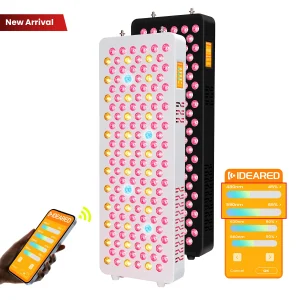
Useful controls make operation repeatable without adding unnecessary complexity. Depending on the product category, buyers may need a timer, 1-100% dimming, separate red/NIR channels, pulse-frequency settings, a remote, touch-screen control or an APP.
The interface should show the active mode clearly and retain important limits. For shared commercial equipment, physical controls may be as important as APP functions because staff need a reliable way to operate the panel without pairing a personal phone.
7. Safety, Documentation and Market-Appropriate Claims
Certificates should be reviewed for scope, model number, issuing body and target market rather than treated as interchangeable logos. Documentation may include electrical safety, electromagnetic compatibility, restricted-substance, quality-management and market-specific records, depending on the product and destination.
Regulatory requirements also depend on intended use and marketing claims. The U.S. FDA guidance on determining whether a product is a medical device explains why products promoted for diagnosing, treating or preventing disease may be regulated differently from general-wellness products. Buyers should obtain market-specific regulatory advice before making medical claims.
8. Supplier Transparency and Quality Control
A reliable supplier should be able to connect a sales specification to a controlled production process. Useful evidence includes incoming-material inspection, LED binning records, assembly checks, aging tests, irradiance test methods, serial or batch traceability, warranty terms and a documented after-sales process.
For B2B projects, compare the manufacturer’s answers across models with the IDEATHERAPY product comparison. Brands that need logo, wavelength, housing, packaging or interface changes can also review available private-label and OEM/ODM options.
A Practical Pre-Purchase Test
- Confirm the exact model, wavelength configuration and LED distribution.
- Request irradiance results at multiple points and realistic distances.
- Check how the supplier calculated or recommends dose and session time.
- Run the device through a full session and observe heat, noise and control stability.
- Verify the power rating, plug, installation method and included accessories.
- Match certificates, reports and labels to the actual model being purchased.
- Confirm warranty coverage, replacement parts and after-sales responsibilities in writing.
Common Red Flags
- Only electrical wattage is advertised, with no optical measurements.
- Irradiance is listed without distance or test conditions.
- Every wavelength is described as having the same purpose.
- Certificates cannot be matched to the model or applicant.
- Medical outcomes are guaranteed without evidence or regulatory context.
- The supplier cannot explain heat management, testing or warranty procedures.
FAQ
What is the most important specification for red light therapy devices?
No single specification determines quality. Wavelength, irradiance, dose, coverage, distance, controls and test conditions must be evaluated together.
Does higher wattage mean a better red light therapy panel?
No. Electrical wattage shows power consumption. It does not by itself prove optical output, coverage uniformity or the dose delivered to the user.
How should irradiance be compared?
Compare measurements taken at the same distance, with the same wavelength mode and clearly stated meter and test method. Area-average data is usually more informative than one center-point peak.
Are more wavelengths always better?
No. The wavelength mix should fit the intended use, and buyers should understand LED distribution and channel control. An unexplained wavelength count is not evidence of better performance.
What documents should a B2B buyer request?
Request the current specification sheet, optical test method, relevant safety and compliance reports, labeling details, quality-control process, warranty terms and documents required for the destination market.
Conclusion
High-quality red light therapy devices are transparent, measurable and appropriate for their intended market. Instead of choosing by LED count or wattage alone, compare the complete system: spectrum, irradiance, dose, coverage, controls, thermal design, documentation and supplier support.






 简体中文
简体中文 Deutsch
 Français
 Português
 Italiano
 Русский
 한국어
한국어 العربية
 日本語
日本語 Svenska
 Polski
 Magyar
 Čeština
 Dansk
Dansk 繁體中文
繁體中文 Nederlands
 Suomi
Suomi Irish
Irish